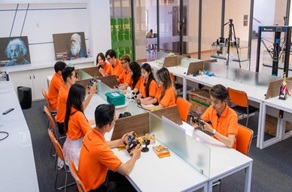
Lạc Hồng University Launches Semiconductor Laboratory to Support Industry Growth
On the morning of December 23, Lạc Hồng University officially inaugurated its new semiconductor laboratory. The university has equipped the facility with cutting-edge tools, including the HAPS 100 KIT, hardware simulation platforms, and advanced semiconductor design software. This laboratory will serve as an essential hub for students and faculty to conduct research and develop practical technology solutions.
The initiative aligns with the anticipated influx of semiconductor investors into Đồng Nai, Bình Dương, and Ho Chi Minh City in the near future.

Strengthening International Collaboration
Lạc Hồng University has also signed a partnership agreement with Arizona State University for training and development. In February, this U.S. institution secured a $13.8 million cooperation agreement from the Bureau of Economic and Business Affairs under the U.S. Department of State. The agreement aims to enhance assembly, testing, and packaging capabilities in select countries, contributing to a more resilient supply chain for U.S. semiconductor manufacturers.
Strategic Workforce Development
According to Nguyễn Hồng Lĩnh, Secretary of Đồng Nai Province, the upcoming launch of Long Thành International Airport will be a key driver for investment. Đồng Nai has been actively preparing large land reserves to attract semiconductor manufacturers. However, he emphasized the importance of aligning workforce training with industry needs.
“We must ensure that our training programs match the specific demands of the industry. It is crucial to survey businesses to understand their workforce requirements, avoiding gaps where needed skills are missing while oversupplying less relevant skills,” he stated.
Vietnam’s Semiconductor Roadmap
Đồng Nai, along with Ho Chi Minh City, Bình Dương, and Bà Rịa – Vũng Tàu, forms the economic quadrangle of Southeast Vietnam. The province currently hosts 33 industrial zones, positioning it as a key player in industrial development.

As part of the national Semiconductor Industry Workforce Development Program, the Vietnamese government aims to train at least 50,000 professionals with university-level qualifications by 2030. This highly skilled workforce will focus on semiconductor chip design, packaging, and testing, gradually mastering advanced manufacturing technologies.
By 2050, Vietnam aspires to build a strong semiconductor workforce that can integrate into the global semiconductor value chain, meeting both qualitative and quantitative industry demands. The government has allocated funding to establish semiconductor laboratories in 18 public universities, reinforcing the country's commitment to high-tech innovation and education.